Book 2: Sarah Ann
Chapter 7: The Will
From the time of her accident until her death in early 1890, my darling daughter, Sarah Etta, was in terrible pain. She often cried and called out for her little daughter, Gracie, who was still living with her aunt and uncle in Pierre, South Dakota. Watching my daughter live with such terrible pain was just barely bearable for me. Her death came as a relief because now she was at peace.
Within days of the funeral, of course, I learned about her will, which was not the one that I thought she had written. While in severe pain after her accident, she managed to write a new will and have it witnessed and signed without my knowledge or her sister Julia’s. We were both immediately shocked when we learned from the lawyer what it said.
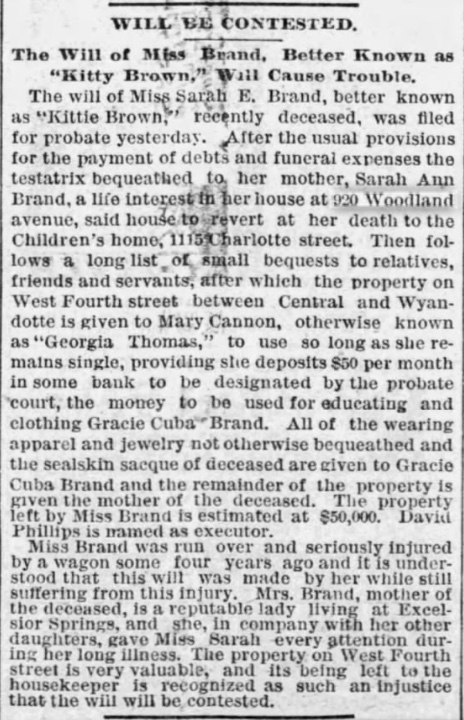
Sarah Etta’s will, signed October 20, 1888, opened with the standard instructions to pay her debts and funeral costs, then moved quickly into a long list of bequests to family and friends. Her father, Baker Brand, received just five dollars — a striking contrast to the hundred dollars she left each of her brothers, S.P. and Leonard W.H. Brand, and her sisters, Julia H. Laramore1 and Effie B. Pierpont. But that was no surprise because Sarah Etta was not happy with her father. She gave me, Sarah Ann Brand, a life interest in the rents and income from the house at 920 Woodland Ave., on condition that I keep it in good repair and current on taxes; upon my death, the property was to pass permanently to the Children’s Home on Charlotte Street. A number of friends and household associates were also remembered, including Mrs. B. Winters (two French statues) and Mrs. Lorna De Camp (her choice of household items or clothing, plus her largest diamond ring, worn on her forefinger). Mrs. A. Drummond and two coloured workers in her employ, Mrs. Georgia Brown and Annie Smith, were each to receive cash and the right to select items from her household goods or wardrobe.
The most detailed provision by far concerned her resort on Third Street and her daughter, Gracie. Sarah Etta left the use, rents, and income of this property to Mary Cannon (also known as Georgia Thomas) for as long as Cannon remained single, on the condition that Cannon pay $50 a month toward Gracie’s education and clothing, keep the property insured, and keep the taxes paid. Upon Cannon’s death or marriage, the property was to pass outright to Gracie. Sarah Etta also left a diamond brooch to Georgia Thomas, and her sealskin cloak, along with the rest of her wardrobe not otherwise given away, to Gracie. A $2,000 debt against the Woodland Ave. property, owed to John A. Moore, was to be paid off from the estate. C.W. Chase received her largest solitaire diamond ring.
Whatever remained of her diamonds, jewelry, and general estate was to be converted to cash. That money was to be used first to buy a burial lot at Union Cemetery and pay for a $300 monument at her grave, with the balance going to me, Sarah Ann Brand. She named David Phillips of Kansas City as her executor.
Finally, she added a contingency: if Gracie Cuba Brand should die without legitimate children, the property set aside for her would instead go to the Children’s Home — the same institution that would receive the house on Woodland after my death.
Julia and I were immediately horrified to learn of this will and we knew that we would have to contest it. There was no other choice. First of all, we wanted to protect little Gracie, Sarah Etta’s daughter. As well, of course, Sarah Etta had been helping to support all of us, and we were certain that she would never have done this if she had been in her right mind. But the accident, resulting in terrible long-term pain, and the use of morphine to control it, were the cause of her distorted vision of the world. We knew that this was wrong, so we began immediately to speak to a lawyer and make arrangements to contest the will. We were angry with the lawyer who wrote up this will, as well, because we believed that he absolutely knew that Sarah Etta had lost her mind. All he wanted was his fee for writing up another will.
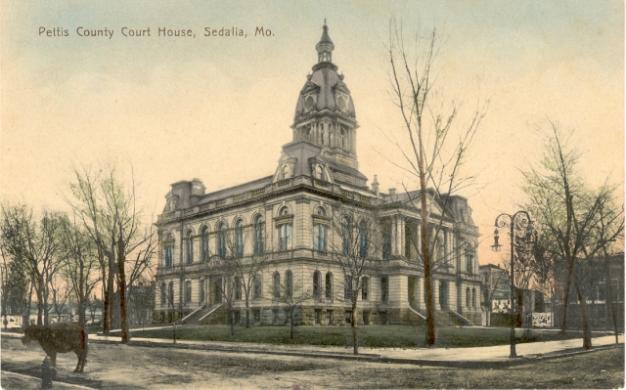
The trial for contesting the will finally arrived and Julia and I were quite nervous and apprehensive about it. Here’s what finally happened:
We brought suit to overturn the will, naming the housekeeper and the city’s orphan home as the primary defendants — the two parties who stood to inherit in the family’s place. The central legal question was simple to state and hard to prove: had my dear daughter, Sarah Etta, been of sound mind when she made her will, or had illness, drugs, and possibly the housekeeper’s influence robbed her of true judgment? Jury selection alone took the better part of a day, as lawyers on both sides worked to exclude anyone with prior experience in will disputes.
Their lawyer called witnesses who had done business with Sarah Etta for years — a saloon keeper who’d known her nearly a decade, an insurance agent who’d handled her real estate — and each testified to the same thing: her judgment in financial and business matters never wavered, before or after her injury. The saloon keeper had personally witnessed the will’s signing and saw nothing amiss in her manner that day or afterward.
Then our lawyer called her longtime doctor, who had treated her after her serious carriage accident years earlier. He described her growing dependence on morphine — starting at fractions of a grain and climbing, by the time of her death, to doses that would be considered enormous. He testified plainly that in the period surrounding when the will was written, she was, in his professional opinion, insane — swinging between apparent competence and delusion, particularly fixated on the belief that her own family wanted her dead so they could seize her property. He connected this directly to both her physical injuries and the drug used to manage them, and noted that both morphine and alcohol were known in his experience to erode family bonds specifically.
A parade of merchants and seamstresses who’d served her for years took the stand next, and, for me, their testimony had a strange, almost gothic consistency: Sarah Etta had bought compulsively and erratically, ordering elaborate gowns she’d never wear, hoarding dozens of dress patterns and untouched silk dresses in storage trunks, having one gown built heavy enough with beadwork that “no man on the jury could have worn it.” One witness described being summoned to fit Sarah Etta for a dress meant only for her own burial. Several noted she required morphine injections just to stand still long enough to be measured. More than one witness broke down or nearly fainted on the stand describing her volatility.
Both Julia and Effie, my two younger daughters, gave the most emotionally fraught testimony — Julia, dressed in black, spoke with obvious grief about years spent guarding Sarah Etta’s interests and watching the accident and the morphine remake her personality; she held up well under questioning. But my poor Effie collapsed in tears during cross-examination and had to be excused from the stand entirely, never returning to testify further. A hired nurse who’d cared for her in her final illness was prevented from giving her opinion on Sarah Etta’s mental state — the court sustained an objection before she could answer.
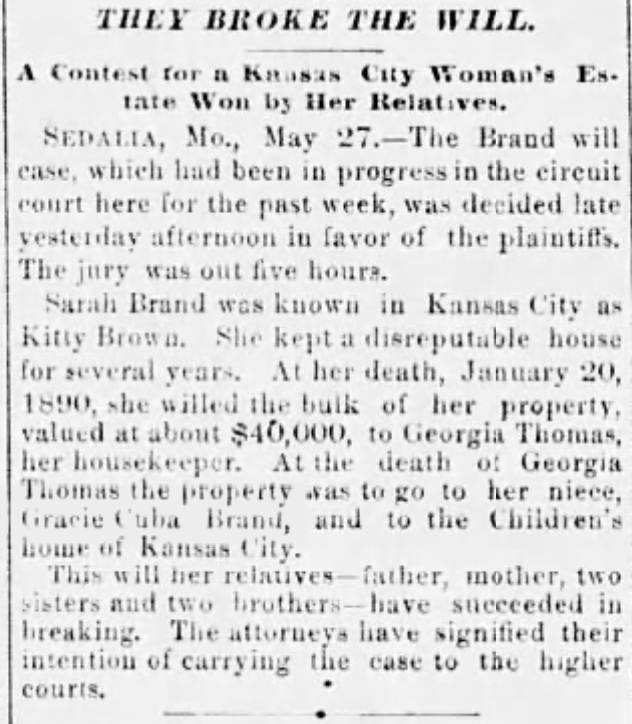
After a week of testimony, and one night where the jury reported themselves deadlocked, they returned the following morning and found in favour of us: the document, therefore, was declared not to be a valid will. Interestingly, before delivering that verdict, one juror asked the court to clarify who Gracie Cuba Brand was — she was identified as a niece, the daughter of my son, Samuel. Julia and I were determined to make sure that little Gracie was always protected from the scourge of gossip about illegitimate children.
After living through my dear sister Clarinda’s ordeal, and then watching my beautiful daughter, Sarah Etta, also deal with the usual male dislike for independent women, I was determined that my granddaughter, Gracie, would have all the opportunities we could give to her. Because Gracie had been mentioned in the will, I felt her rights had to be defended at the trial. So I hired a lawyer to work on her behalf and I telegrammed my son, Samuel, and told him that Gracie had to come to Kansas City immediately. He and his wife, Martha, were reluctant to send Gracie to me, but I insisted and they knew they couldn’t really change anything. They were living in Pierre, South Dakota, at the time, where my son worked as a carpenter. Martha accompanied Gracie, who was now 11 years old, as far as Minnesota (where they had once lived in Waseca), and then Julia had gone north to meet Gracie and accompany her to Kansas City.
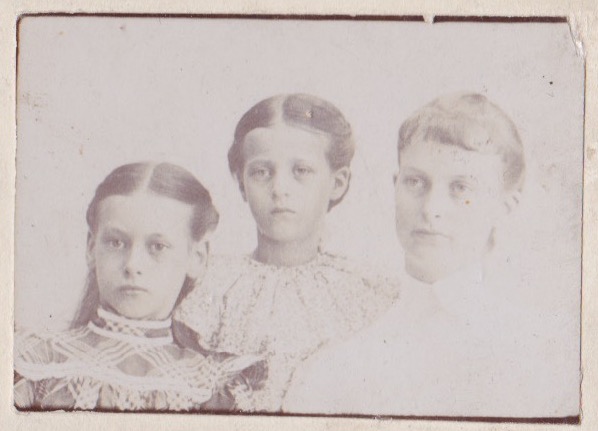
When I met Julia and Gracie at the train station, I was amazed at how much Gracie had grown and how beautiful she was becoming — just like her mother. But she was very different from her mother in one other way: while her mother was outgoing and constantly active, Gracie was quiet and reserved and almost fearful. She understood little about what was going on, and Julia and I tried to protect her from some of the gossip which was occurring ever since Sarah Etta had died and news of her will had been published in the paper. Everyone wanted to know who this “Gracie Cuba Brand” was, including the jury at the trial.
We didn’t let Gracie attend the trial, but the lawyer I had hired would protect her interests there. Instead, we got Gracie enrolled in school and, whenever possible, Julia or I would drop by the school to pick her up. She went to Woodland School, at 711 Woodland, just two blocks from Sarah Etta’s house at 920 Woodland, where Julia and I had been staying since her accident. We were pleased that the school was so close by. Gracie was quite lost and confused at first, but getting her into school and keeping her occupied helped her to adjust. She finished Grade 7 there and then moved on to Central High School, which was at the corner of 11th Street and Locust. She had to walk ten blocks west and then one block south. My darling Sarah Etta was gone, but her daughter began to thrive and I was so proud of her.
Author’s Note: The women in Sisters were real people, and I have told their story as accurately as I can for lives lived in the 19th century. I can prove and support many of the facts with records from the time. But no record can tell me exactly what someone said, and for some events I know only portions of the story. So I have also had to use my imagination, to put you, the reader, inside the head of each woman as she tells her own story.
-
After she moved to Kansas City, Julia frequently changed the spelling and pronunciation of her married name. Just as Sarah Etta changed her name to Kitty Brown while she worked, Julia changed her name to Daisy Brown when she was working in Kitty’s resorts. As well, Julia used many variations of her name in the city directories. ↩︎