Book 2: Sarah Ann
Chapter 8: Looking Back
Today, I celebrate my 62nd birthday — 5 February 1893. I don’t know how many years I have left, but it’s been a life full of extremely difficult and emotional lows as well as wonderful highs, especially with my children.
My mother and father — Tryphena Perkins Higby and Abijah Isaac Higby — had a strong influence on me. My mother gave birth ten times to bring me and my siblings into the world. Not all of us survived — Cyrus, just two months old; Clarinda, dying amongst criminals; Norman, just four months old; Salmon, just a year old; James Knox, lost to us when he was only 28 years old; and little Kay, just two years old when she passed.
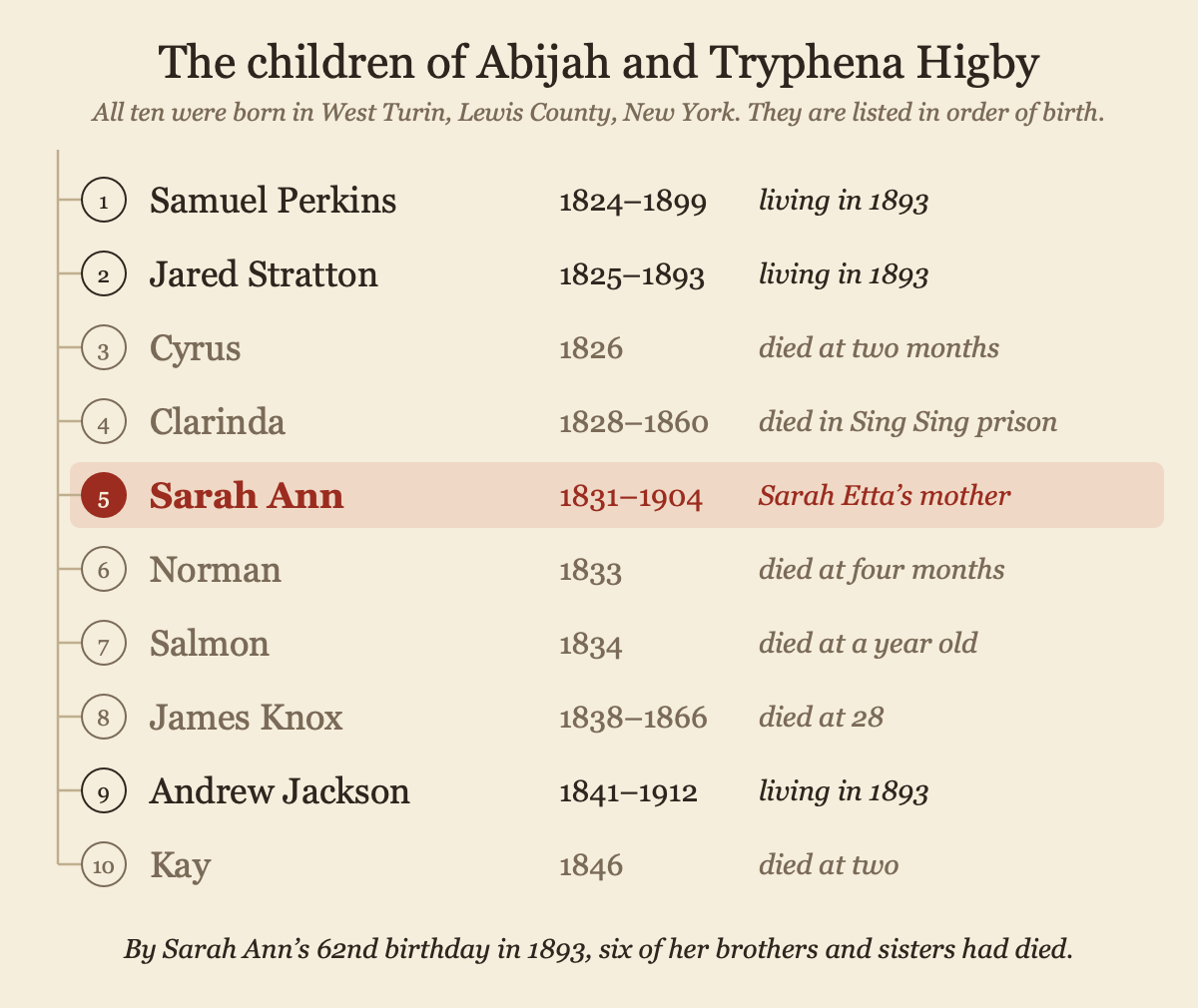
I was my mother’s 5th child, her second daughter, and I have thus far outlived six of my siblings with only brothers left: Samuel Perkins, Jared Stratton, and Andrew Jackson. My brothers have remained in West Turin, New York, where all of us were born, but after Clarinda’s terrible ordeal, I could no longer live there. My mother, completely crushed by what happened to Clarinda, died just six years after Clarinda — in 1867. My father remarried but he also soon gave in, passing away just four years after my mother — in 1871.
Growing up in West Turin was not all bad and difficult, but my sister and I figured out from a fairly early age that girls were not treated the same as boys. I saw this unfairness on a daily basis with my brothers — particularly Samuel and Jared — getting far more freedom to do what they wanted to do than Clarinda and I had. Watching them grow up, I knew they were going to find life just generally easier for them than it was for us women.
As Clarinda’s marriage fell apart and she attempted to end it, I saw her struggles and understood how desperate she was. I talked to my father and to Baker, my husband, to try to figure out how I could help Clarinda. But the laws were never on her side. I was afraid she might do something rash — and I kept trying to tell her that she must not do anything to harm James. I was hoping, somehow, that I could help her find a way to end her marriage yet keep her children. No matter what I did, however, her situation just got worse with every passing day. Ultimately, her decision to murder James was hers alone, but I felt guilty about it, believing that perhaps I might have done something to make her believe that she had no other option. Attending her trial was one of the most difficult things I have ever done and I knew that she would probably not avoid prison time.
After her conviction, living in West Turin became almost impossible. But I remained at first, hoping that I might be able to help with an appeal. During that time, I was unable to successfully carry a child to full term, and I lost a boy, Cassius, in 1862, just two years after Clarinda’s death. Before I convinced Baker to leave West Turin, I gave birth to two beautiful daughters: Julia Harriet and Bessie. Once I had convinced Baker that we had to leave, I felt tremendous relief that I no longer had to endure the stares and innuendoes that I experienced every time I went to town to buy something.
Like Clarinda, I didn’t want to remain married to Baker, but I was determined to wait until the right moment. As laws began to change, I knew my chance at divorce was coming closer every single day. And it finally came. After our divorce, Sarah Etta headed for Kansas City to try to find a life for herself — she was never going to end up like her Aunt Clarinda — and to help out with the family’s finances.
Unfortunately, although laws had improved for women, they had not changed a great deal. Deciding to work as a fancy lady and then to own her own establishment was genius on Sarah Etta’s part. If she had not fallen in love and found herself pregnant, perhaps her life would have been quite different. But I have learned that there is no point in crying over spilled milk — what will be will be. Sarah Etta did a remarkable job of taking care of herself and helping out her family as well. But she never got over the loss of her baby’s father and the fact that she couldn’t have Gracie with her in Kansas City.
Since her death, Julia and I have tried hard to make Gracie’s life not just “good” but we wanted her to have a chance to do something with her life. After Sarah Etta’s death and after we had settled the messy will, Julia and I concentrated on Gracie. We made sure that she will finish school and we hope that she is going to become a nurse; that is what she says she is interested in.
Several years ago, I met a man named John Kell. When I met him, he was still married to someone else, but his wife died in 1891. We were married on 10 November 1892. This has not been the same marriage I had with Baker. First of all, we are beyond worrying or thinking about having children. I am glad that part of my life is over. John and I are “equal” in all ways. We keep our finances separated; we both support ourselves. We enjoy doing things together — something that Baker and I rarely did. I don’t know how many years I have left, but marriage to John was a good decision.
So on my 62nd birthday, it is easy to look back and see the good things — and the pain of loss. I would have wished that my beautiful Sarah Etta and Bessie would have lived longer, but I still have Julia and Effie.
Author’s Note: The women in Sisters were real people, and I have told their story as accurately as I can for lives lived in the 19th century. I can prove and support many of the facts with records from the time. But no record can tell me exactly what someone said, and for some events I know only portions of the story. So I have also had to use my imagination, to put you, the reader, inside the head of each woman as she tells her own story.