Book 2: Sarah Ann
Chapter 6: The Accident
Not too long ago, I found the journal that my daughter, Sarah Etta Brand, had written, telling about her life up until Thanksgiving of 1885 when she was involved in a terrible carriage accident at 6th and Broadway in Kansas City.
She and Prince were running errands, I guess, and the streets were bustling with activity because of the Thanksgiving holidays. The intersection was crowded and Sarah Etta was undoubtedly impatient, a trait I had noticed in her even as a very young girl. Prince was startled by something and reared up, causing the carriage to lunge forward. Sarah Etta was thrown out of the carriage and fell to the ground. In the confusion of that moment, the wheel of a large nearby dray rolled over her hips and she screamed in agony and terror. At that moment, her life changed forever.
Julia sent me a telegram — I was still living in Rice County, Minnesota — to tell me of this terrible accident. I knew right away that she’d be dealing with difficult health issues for months, so I packed my bags and headed to Kansas City. Both Julia and I nursed her for months. I purchased a small house in Excelsior Springs and I went there a few times each week while Julia took over the nursing duties. Julia and Sarah Etta lived together, as a matter of necessity, at Sarah Etta’s house at 920 Woodland Avenue.
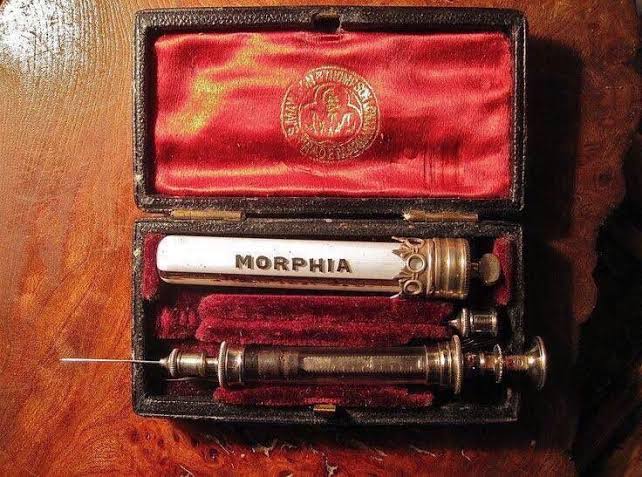
Sarah Etta was in such great pain that she needed morphine almost constantly. The doctors would inject it, and then she learned how to do it herself. The use of morphine was habitual with her from the time she commenced using it and the quantity increased from the first. At the beginning, the doctor told me that she took from one-half to three-fourths of a grain, and towards the last she took from three to four grains. I didn’t understand this term “grains” but I knew that she was increasing her usage. Between the terrible injury itself, which caused constant pain, and the increasing use of morphine, it was difficult to watch her slow descent into madness. From June 1888 to January 1890, when she died, she was, in my view, insane. Her mind was impaired and she did such crazy things. Many people with whom I talked also confirmed my feelings. The whole situation was, for Julia and me, almost unbearable.
For instance, she started wearing heavy winter clothing in the middle of the summer. I first noticed the change in the spring of 1888, when I found her in a towering rage and tried to quiet her. She seemed to be under the impression that Julia and I wanted her out of the way to “get her stuff.” The injury she sustained or the use of morphine to which she was addicted — or a combination of both — was clearly causing her extreme physical and mental distress.
Julia and I worried constantly about her and we did everything we could to help her get through this ordeal, though neither of us could quite imagine how that would happen. After all the years she had lived in Kansas City, she knew a lot of people and frequented the same stores. Everyone noticed how changed she had become.
She was a frequent visitor at the firm of Bullene, Moore, Emery & Co., for instance, and she got to know some of the clerks better than others. After her accident, she often purchased large quantities of items and left them to be delivered — and many were never delivered. Many people thought she was insane and expressed their concern to me and to Julia. I was told that she would come into the store in an excited manner and rush from one part of the store to the other, looking at goods, never stopping very long to examine them and ordering nearly everything she took a fancy to. She was a fairly good buyer before she received her injury and the change in her manner after the injury was very marked.
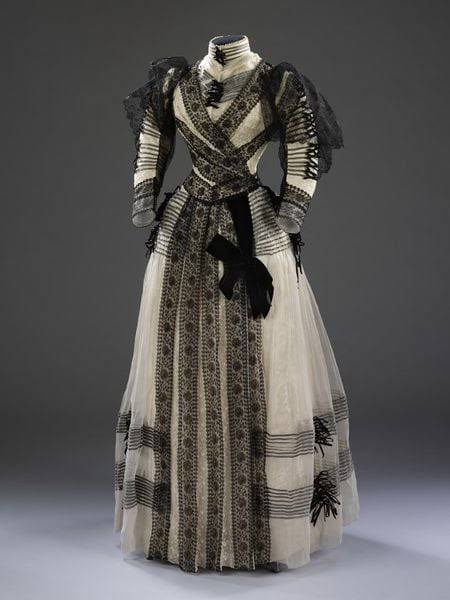
She also often went to A.N. Sloss’ millinery establishment — she loved this shop which was located at 1117 Main Street. It had been opened in 1879, and Sarah Etta had gone to Kansas City just four years before. The clerks in that store knew Sarah Etta by her professional name, Kitty Brown. Sometimes clerks from this store would come to Sarah Etta’s house to measure her for a dress. Sarah Etta gave one clerk an order for a dress trimmed with twenty-five pounds of jet. It was so heavy that it would have been impossible to wear. No one could convince her that it was a huge waste of money.
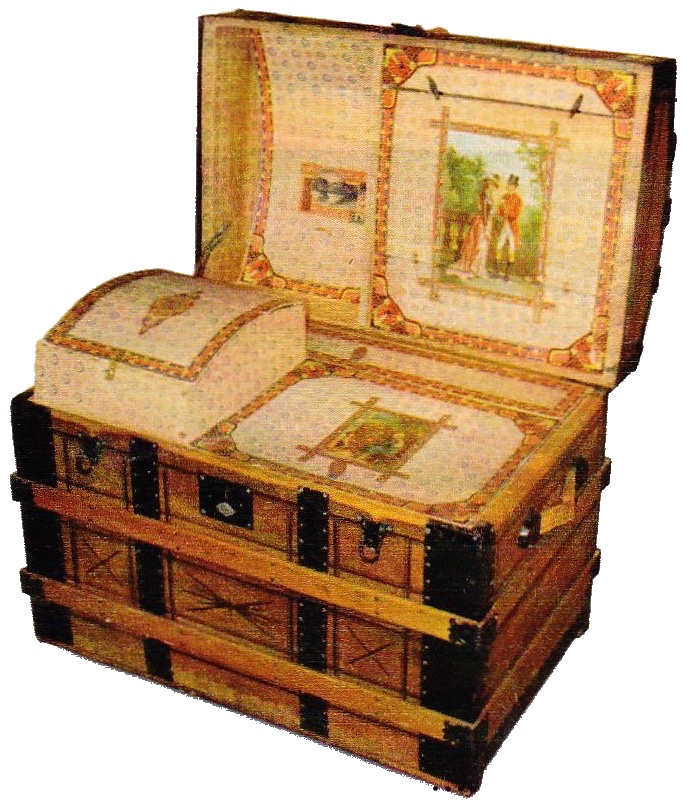
I found one day in Sarah Etta’s bedroom a Saratoga trunk which contained from 100 to 200 dress patterns and she had a wardrobe which contained thirty fine silk dresses that she had never worn. She said she never expected to wear any of the dresses she had in the trunk except a black satin one, which she wanted to be buried in. When she was being measured for a dress, she had to have two injections of morphine just to stand long enough to have her measurements taken.
I was so worried about her. She was sane on some subjects and crazy on others. I just knew that her mind was unsound. She would yell at me and at Julia and every day was a trial to deal with her. Julia and I arranged for her to go to several hot springs in the area in the hope that that would relieve some of her pain. Julia and I worked with her doctor, Dr. Halley, who had been called in to see her right after the accident. Another doctor, Dr. Michaels, also tried to help. They both took care of her at the beginning. At one point Dr. Halley thought to perform an operation but Sarah Etta was so upset when discussing it that he decided against it.
Sometimes store attendants came to the house where Julia and Sarah Etta were living and tried to arrange orders for her. Mrs. M.J. Jacobs was a dressmaker whom Sarah Etta had first worked for when she came to Kansas City, but she told me after Sarah Etta’s accident that she considered her insane. She said that Sarah Etta was disturbingly variable in giving an order — and the next day she would countermand it and say she had never given an order the previous day. She even told me that she was a little bit afraid of her — she commented that the expression in her eyes and her general actions bothered her.

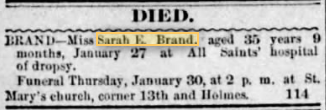
Sarah Etta could be mean to both Julia and me, but we understood that she was no longer in her right mind. Sarah Etta and I had had a great bond for years, but this terrible accident changed everything. Every night I went to sleep disturbed by the agony she was in. I couldn’t see how it could possibly ever end well — and it didn’t. She was admitted to hospital and a few days later she passed on January 27, 1890. She was 36 years 9 months old — my truly lovely and beautiful daughter. Her funeral was Thursday, January 30, 1890, at 2 pm at St. Mary’s Church at the corner of 13th and Holmes. I didn’t want to lose my daughter — I have lost enough children already — but I was glad that she was no longer in pain and she was hopefully at peace. But I had to consider another person now: Sarah Etta’s daughter, Grace. I had promised Sarah Etta that I would make sure her daughter was taken care of and eventually knew who her mother was.
However, on the day of the funeral, I had no idea what battle was yet to come.