Book 3: Julia
Chapter 11: Connecting with Grace
My mother and I felt that Gracie needed to be in Kansas City as soon as we knew that Sarah Etta had written a will which just didn’t make sense. My beloved older sister was clearly affected by the morphine she took for the pain after her accident. We had to protect her daughter’s rights to her mother’s estate while we also protected our own.
But it was a lot for a 10-year-old child to take in. We had taken her away from the only family she knew — my brother, Samuel; his wife, Martha; and their daughter, Caroline, and son, Fred. She had lived a quiet life in quiet farm areas and her Uncle Samuel suffered from paranoia (he was hospitalized in Kansas City for nearly a decade in the early 20th century), so she had learned to be quiet and not bother the adults in the family.
Both my mother and I were very involved with the trial in order to break the will and we didn’t want to subject Gracie to all that unpleasantness. So, while her lawyer protected her rights during the court trial, we enrolled Gracie in school. She was shy and timid, but she did like to learn and she took to her studies quickly and easily. Even during the trial, though, she was coming home to live with me, eat her meals, and sleep.
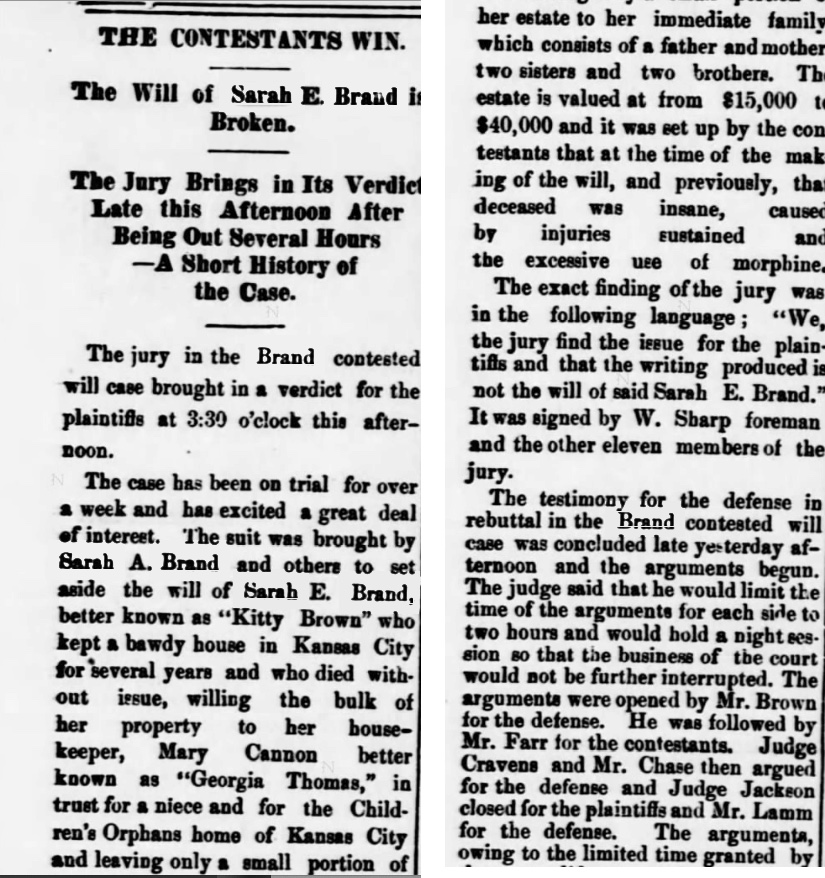
After the trial, things got much easier and I had more time to spend with her. Just like Sarah Etta and I had been somewhat overwhelmed by the big city, Gracie was also a little nervous. But, as time went by, and I took her to more and more activities, she opened up a little. It wasn’t in her nature, however, to be talkative and outgoing. Learning that she had no father was difficult for her to accept and the confusion about her middle name being Cuba remained with her. Even my mother and I were not completely sure what Sarah Etta’s motives were, but we knew that she thought it would provide a hint to Gracie about who her father was.
Gracie had spent plenty of time in cold, snowy weather, having lived first in Minnesota and then in South Dakota, before she came to live with Mother and me. There were three storms, two of which were great fun and we built snowmen and walked through the streets where it was so quiet you could have heard a pin drop. There was a big snowstorm in February 1894 when more than 15” fell in two days; another February storm in 1899 was very cold — below 20°F for nearly three days; and nearly a foot of snow fell in one day on 27 February 1900. Gracie and I liked the snow, but we were not crazy about the cold.
I felt that the best way to help Gracie adjust was to keep her busy and to show her that her grandmother and her aunt loved her dearly. I tried to be home when she came home from school; I couldn’t always do that during the trial, but once that was done, I was usually able to leave work at the Alamo Building and come home to take care of Gracie. We would talk about her day and I’d help her with her homework if she needed it (but she rarely needed it).
Every fall, Kansas City held a grand festival. It was spectacular and to a little girl like Gracie it was pretty thrilling. It was based on Greek mythology and every year they had a float carrying the goddess Athena. The floats were pulled by horses or mules and to add to the excitement they were lit by torches. It was quite a sight to see. I took Gracie to several of these parades, but I don’t remember which years.
On May 14, 1893, Fairmount Park opened and Gracie was 13 — just the right age for such a park. It was an amusement park, located out toward the edge of the city (toward Independence, Missouri). We could reach it by train for 15 cents! There was a large lake where you could ride in a boat; there was a dancing pavilion and an electric fountain that was lit up in colours at night. One time I went with her through the Crystal Maze — a mirror maze. We learned that you could get through it easily if you looked down at the floor and followed the boards which led to the next section. There were also balloon ascensions and parachute jumps — but Gracie had no desire to try either of those. Nor did I! The park was open every year and Gracie went to it several times. I don’t remember how many.
As each year passed and Gracie became more comfortable with her new reality, she did open up a little bit. But she never really got over knowing that she was illegitimate and she didn’t want people to know. I had no problem telling people I was her mother, but I’m not sure that she was happy about that. But the reality is that we became very close and she did think of me almost like her mother.
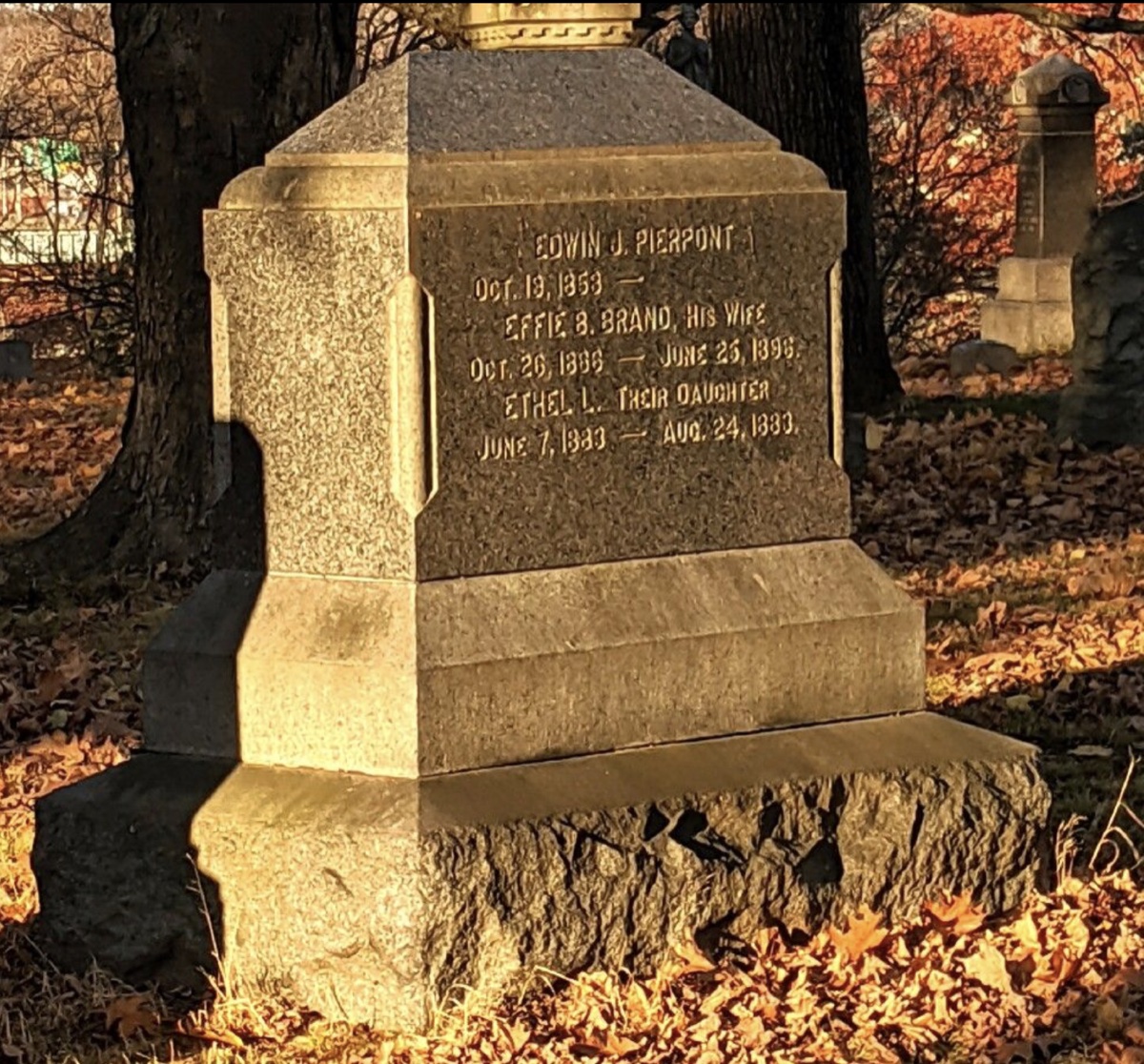
My sister Effie died on June 25, 1896, and for several days, my mother, Gracie, and I were quiet and still. Effie and her husband had moved to Tucson, hoping that the dry air would help her fight off tuberculosis. But, in the end, she was unable to do that. We didn’t feel that we had the time to go to Tucson for the funeral, but her body was taken to New Haven, Connecticut, for burial because that is where her husband was from. When the body came through Kansas City, we went to view the body and talk to her husband.
A few days after that, I took Gracie to Swope Park. This was a new park that had opened recently (actually it was on the same day that Effie died) and I thought that going to the park would help Gracie to deal with another loss. It was a beautiful park — just lots of places to walk and look at nature. There were trails that wound through woodlands and grassy meadows. Gracie loved it because it was more of what she was used to.
Gracie and I had many conversations about what she might want to do with her life. Mother and I were determined to help her find a skill or trade — something that would allow her to take care of herself. Things were a lot different for women than they had been for Aunt Clarinda, whose troubles had occurred more than 30 years before. At some point, perhaps while she was attending high school, Gracie told me that she liked the idea of becoming a nurse. So we began to make that her goal.
I married James Alan Ham on 5 June 1893, but Gracie continued to live with us, or sometimes at her grandmother’s house, throughout the 1890s. She was busy with school, and then nursing school. Once she got to nursing school, she lived with other student nurses who were in training.
Perhaps one of the biggest thrills that Gracie and I shared was going to Buffalo Bill’s Wild West Show in October of 1896 when Gracie was 17. Such an exciting experience and one I know that my sister, Sarah Etta, would have loved. Most remarkable of all was Annie Oakley, the woman sharpshooter. We loved her!
Gracie always loved to read. She would read for hours and hours. When the new public library opened on September 1, 1897, she was thrilled. We both went to see this beautiful new building. The interior stacks had glass floor panels which allowed natural light to filter down through the stacks. The upper floors housed the Western Gallery of Art; it had historical paintings, sculptures, and art collections. Gracie loved to just go there and sit — it was private and it was quiet.
By the end of the century, Gracie turned 20 and she was involved in going to nursing school. She lived in a dormitory with other nursing students, so I didn’t see her as often, but we got together as often as we could. We still did things together and one I remember well was going to see the Electric Park. It opened in the East Bottoms in June of 1900. There were thousands of electric lights, a coloured fountain with shows every night, and singers. Beer was piped straight from the Heim brewery next door — but by then Gracie was a total teetotaler and would not touch anything alcoholic. Perhaps she realized that her mother drank too much and she didn’t want to become dependent on it; perhaps, as well, her religion told her not to drink. Three years before, she had participated in a speaking contest sponsored by the Woman’s Christian Temperance Union, and her topic was, “What shall we do with the Saloon?” She had won first place and received a gold medal. I learned early not to argue with her on that particular topic.
So from 1890 through to 1910, I helped Gracie as much as I could. We grew close and we loved each other. I was proud of her accomplishments in nursing. She worked hard and did well. I don’t think she was ever comfortable with her birthright, though, and she never admitted to anyone that Sarah Etta was her mother. She did meet a nice young man and they got engaged, but then she decided that she wanted to leave the hustle and bustle of the city and she applied for a job in Caton, New York, to be the nurse to an elderly lady. That job would lead her into new directions. In the meantime, we always stayed in touch.
Author’s Note: The women in Sisters were real people, and I have told their story as accurately as I can for lives lived in the 19th century. I can prove and support many of the facts with records from the time. But no record can tell me exactly what someone said, and for some events I know only portions of the story. So I have also had to use my imagination, to put you, the reader, inside the head of each woman as she tells her own story.