Book 1: Sarah Etta
Chapter 3: Life in Kansas City
In 1875, when I was 22, I travelled by train to Kansas City — but this time I was alone, not with my parents and my older and younger siblings. The train headed south through Iowa first and then reached Chicago; I then took a train southwest to Kansas City. It was a three-day trip; my mother was concerned that I was travelling alone, but I was determined to go even though it wasn’t common for women to travel alone. I was going to be my own person and make my own way in the world — without a husband. I think you could say that I was almost giddy with anticipation.
Kansas City was wonderful and I loved everything about it: the noise, the bustle, the activity, people coming and going. It was all such a delight. I started working for a woman who made clothes for the boarders who were in the “West Bottoms” area and, as I got to know these women, I realized that I might be able to find a more lucrative lifestyle as a fancy lady than as a dressmaker, but I took my time to figure out the situation and what might be the best way for me to earn an income.
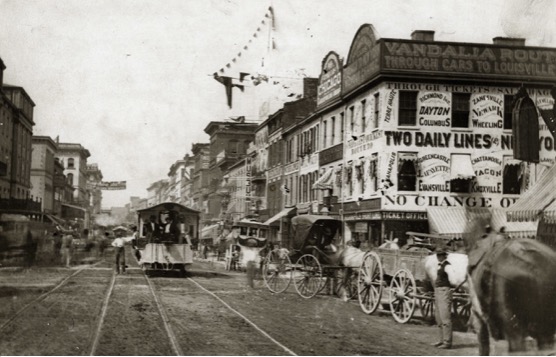
After I arrived, I was curious about what was going on and why, trying to figure out how to make some money and be on my own. I had learned from my grandfather and my mother that one way to earn a living was to own property and rent it or sell it. Unlike the situation my aunt Clarinda was in just 15 years before, I now had the right to own and sell property. So, getting to know Kansas City and its various areas, how people earned money, and how I could make use of the world I was living in — all of that became important to me. It didn’t take long for me to understand some of the history of the area and why Kansas City was booming when I arrived. Essentially, I studied and listened and learned as much as I could about the area. If I was going to make my way in the world, I figured I could learn from others who had helped to develop Kansas City. I talked to the locals — people who had been living here for a while — and I even spent time checking out newspaper articles, too.
Kansas City is virtually in the middle of the United States, where the longest river in the country, the Missouri, meets the Kansas. The Missouri River was like a lifeline for travellers, taking them all the way west as far as they could go by boat. It was way faster than traveling on land. But this particular bend in the river became a natural spot for travellers to rest and get ready for their next move. That’s where they built the Union Station and most of the bars and resorts — convenient for the men as they got off the train. This area became known as “The Bottoms” and it is where I would eventually spend most of my time.
In the very early days, French explorers from St. Louis had moved up the Missouri River, trapping for furs and trading with the local tribes. The United States bought this entire area from France in 1803; it was called the Louisiana Purchase, and people started settling there not long after that. But the area wasn’t settled by just one person. It took the efforts of many to make it boom.
Everyone knew about François Chouteau, for instance, a French fur trader who set up a trading post at the bend of the Missouri, but after a massive flood, he moved the post to the south bank near the foot of present-day Grand Avenue (which is where I would start my first business). It didn’t take me long to learn that flooding could be a major problem for Kansas Citians, especially if you lived near the river. I was concerned about what might happen to my property if a flood occurred.
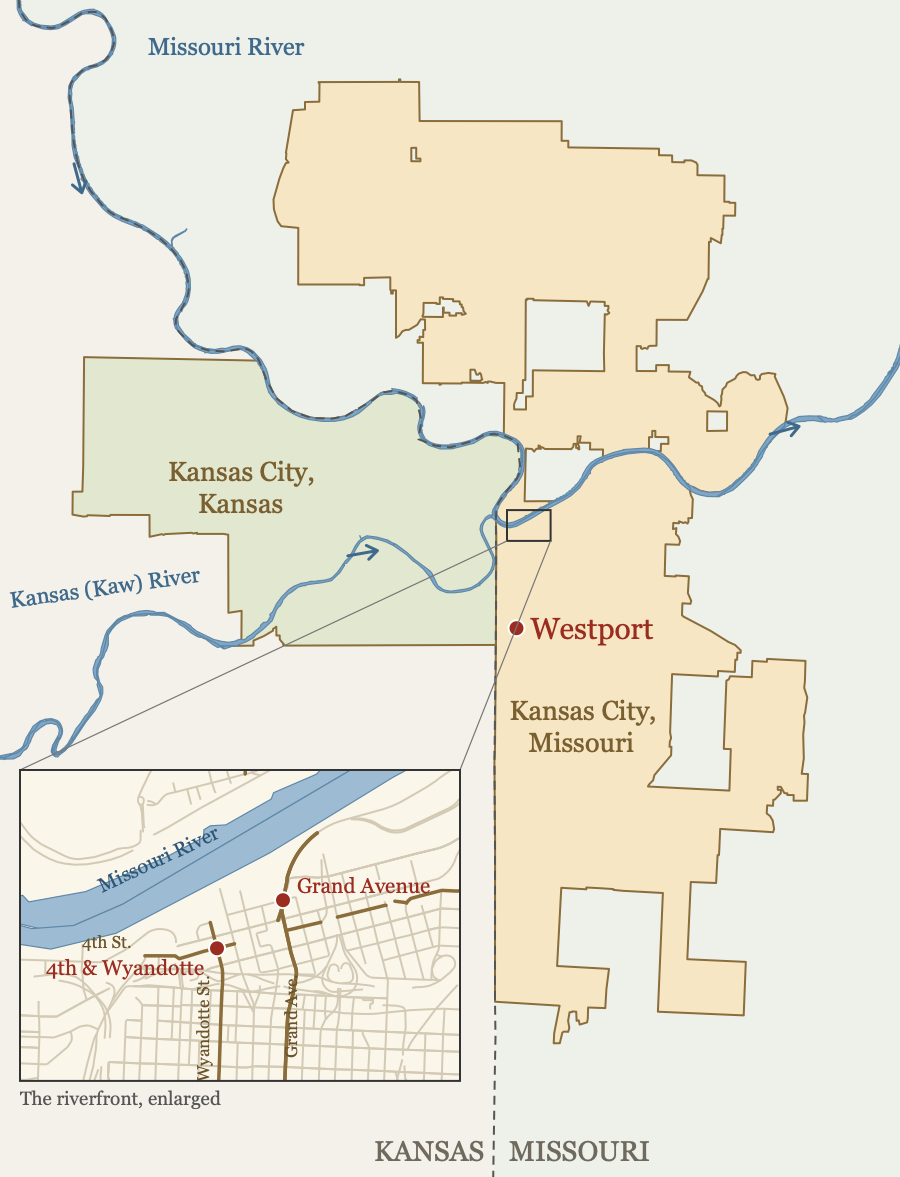
Westport was the first town in the area, established by a man named John McCoy. Like me, he saw the potential for earning a living here: he opened an outfitting store for pioneers who were heading down the Santa Fe Trail. He also built a riverboat landing on the bluffs at the bend in the Missouri River. Westport, therefore, became popular because it was close to Kansas Territory and because settlers and traders could trade with the Indian tribes who had been forced to move there in the 1830s.
In 1838, fifteen years before I was born, fourteen men decided to expand the town’s boundaries and grab some land along the river. They included Westport Landing in their plans, and in 1850, they officially became the Town of Kansas. The name Kansas City comes from the Kansas, or Kaw, River, which was named after the Kansa Indians. Later on, in 1853, the state of Missouri decided to incorporate the area as the City of Kansas, which is exactly what it was called when I first arrived.
Once the railroad arrived in Kansas City in 1865, it was like a magic wand that connected the city to all sorts of trade networks. This massive development really boosted Kansas City’s growth. But what really opened up the area was the Hannibal Bridge over the Missouri River, completed in 1869, just six years before I arrived. This bridge transformed Kansas City into a major transportation hub, and, despite the competition with some other cities, once the decision was made to build the bridge, it was obvious to me that it became the undisputed champion of the region.
In essence, geography played a huge role in developing Kansas City — and making it a great place for me to make a living. In the past, the river’s confluence made Kansas City an irresistible spot for Native peoples, then French traders, and finally, American settlers. Eventually, railroad investors couldn’t resist either, so each group built on what the previous one had accomplished. I just latched on to those stars and made my way.
Kansas City was a real hotspot for travellers and many workers, especially men. When I arrived, Kansas City was at the height of the Texas cattle drives. The men arriving were not just railroad workers — they were trail bosses, cattle barons, and cowboys flush with money after months on the trail. Many of these men were anxious to drop by my establishment. They came in droves, and there were certain activities they liked to do best: gambling, drinking, and hanging out at saloons and houses around the old Union Depot in the West Bottoms area. The city’s railroad boom brought in all sorts of folks, like cowboys and westward migrants. Young, unmarried men outnumbered us women by a landslide, so they flocked to the 80 saloons and 40 houses of prostitution that catered to the bustling population of 50,000.
I figured out that many women hung out around military forts, trading posts, mining camps, and cattle towns, trading their bodies for some cash. It was a way for some women to escape the not-so-great jobs they had as laundresses, maids, and factory workers. In many cases, it was their only chance to make a living without family support or money. I was determined to use this business to make a name for myself and, in the meantime, I was also helping other women to find their independence.
By 1880 — when I had already purchased one resort and was hoping to buy another one soon — the city enacted its first “sin laws.” But by then, these resorts were well established, including Annie Chambers’ mansion at 201 West 3rd Street. Even though she was only a few blocks from police headquarters, her resort was never raided, nor was mine. My house was on the same block as hers, also facing Third Street. Annie was here a little before me and she became quite well known, but I truly think that most of the men liked my place better than hers. Annie had a bit of a sanctimonious attitude toward her girls, and she kept a tight ship. I had a few girls come to my place after they had been in Annie’s and they liked my style of leadership better than Annie’s. Mainly, I gave them more freedom than Annie did. City governments in the region actually profited from prostitution by fining my girls and me as the owner. The “sporting woman” was also seen as a necessary evil since she attracted potential business. And we did that — oh, yes indeed, we did that.
I quickly learned by observing others that I wanted to run a resort of my own — a place where my boarders would be safe. There were many different “arrangements.” At the top were the parlour houses — establishments like my resort, where the surroundings were luxurious, the women were well-dressed and well-versed in social graces, wine and cigars were served, and the prices reflected all of that. When I worked for another madam, I charged up to $10 and gave half to her; once I became the madam myself, of course, that arrangement reversed. I wanted my resorts to be beautiful and comfortable — a place where the clients could come and relax, rest, and have fun.
Once I had purchased a resort, my name began to appear in the papers when my girls and I were “arrested” and “fined” for having a “house of ill repute.” It became almost a joke, really, and it was, in many ways, free advertising: the newspaper comments brought me more customers.
By 1879, I was listed in Hoye’s directory, which listed people in Kansas City. Early on, I chose the name Kitty Brown as my professional name. It took time to purchase the things I wanted for my resort. I wanted comfortable but attractive furniture, a room where the men could relax and sit and talk, smoke their cigars, and perhaps get to know the girls. We were open at all times of the day and night, and I stayed there as much as I could. I wanted to be there if there was trouble and, alas, sometimes there was, simply because young men get drunk and sometimes get silly or jealous or angry.
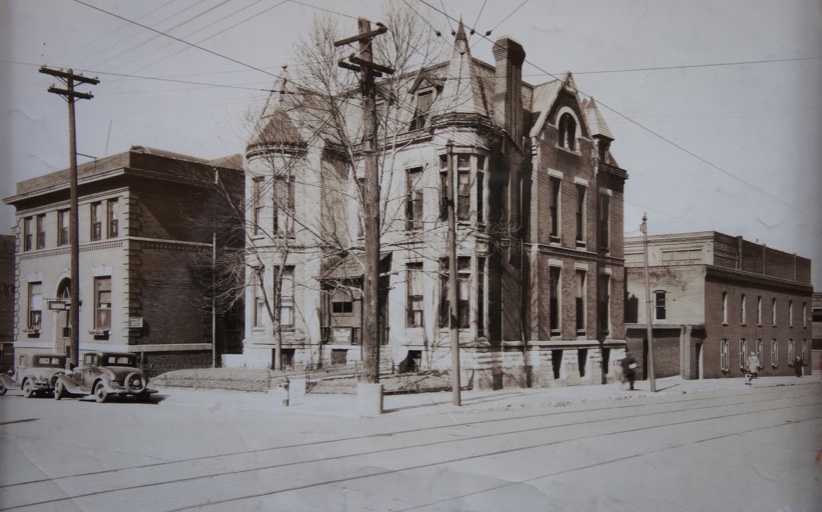
There were resorts like mine and Annie’s, but there were also just ordinary houses. They were decent enough, but they lacked the elegance and the high prices of resorts like mine. Then, there were these places called cribs and they were referred to as 25-cent houses. They were very small and cheap, sometimes just a single room with a door to the street. In these cribs, a woman would sit or stand in the doorway, trying to entice men inside. The women who worked in these cribs barely made ends meet. They often paid a lot of rent to the crib owner and lived in very poor conditions. It was a stark contrast to the parlour houses, and there was no way I was going to work in those conditions.
Because I eventually owned two resorts, I was at the upper end of this hierarchy. I wasn’t a crib worker or a streetwalker — heaven forbid. I was a businesswoman who accumulated enough capital to purchase real property. That was genuinely unusual and I showed that I was capable of making it on my own. In a world where most women in the trade ended up impoverished, sick, or dependent on a madam, I became the madam herself — and a property-owning one at that. I went from dressmaker to working girl in remarkably short order, and I met a lot of important people. It wasn’t just cowboys and dock workers who came to my place, even before I was the madam. Men of high rank — in politics, in the business world, in finance — also were my regular trade.
Shortly before I purchased my first resort, however, I did the very thing I told my girls to never do: I fell in love with one of my clients. This was something I had not intended to do. However, he was tall, dark, and handsome, which is a bit of a cliché, but it was really true. I can still remember the first time he came into my resort: He was a bit shy but curious about me, my life, and how I lived. The first thing he told me was that he made Cuban cigars for a living, which didn’t seem like anything particularly exciting, but he had a slight Cuban accent, a quiet demeanour, and he treated me like a queen, bringing me gifts each time he came. His schedule was somewhat erratic, but he came to see me at least twice a week.
Unfortunately, he was also married. And, despite my efforts to prevent it, I found myself pregnant in late 1878. I wanted a child but I also wanted a husband. It was not a good situation for me or for my child — and I turned to my mother and sister for advice and help. All of my careful planning had not prepared me for this new twist.