Breathing & Relaxation Are Important to Our Health
by Susan Ingraham, BCRPA-certified fitness instructor for older adults
We do it every day, seven days a week: We breathe. We rarely even think about it, yet, like every other part of our body, our lungs require care as well as exercise.
While breathing in, we take in oxygen; while breathing out, we eliminate carbon dioxide and water. With the help of the heart, this process — a complex one which will not be described here — delivers oxygen to the body. Many people don’t realize that the build-up of carbon dioxide — even more than the lack of oxygen — is what causes us to take a breath.
Responding to our body’s needs at any given moment, the brain regulates the rate and depth of breathing so that the right amount of oxygen is delivered to the muscles and organs. During rest, carbon dioxide levels — and therefore breathing rates — are lower. By contrast, carbon dioxide levels in the blood increase during exercise, and so breathing rates go up.
Breathing rates vary from person to person. The average respiratory rate reported in a healthy adult at rest is usually given as 12 breaths per minute. Sometimes, at the end of fitness class, I ask you to listen to your breathing. Chances are, it’s a bit higher right after exercise and will slow down as you relax.
According to Wikipedia, average respiratory rates per minute by age are:
- Newborns: 44 breaths
- Infants: 20–40 breaths
- Preschool children: 20–30 breaths
- Older children: 16–25 breaths
- Adults: 12–20 breaths
- Adults during strenuous exercise: 35–45 breaths
- Athletes’ peak: 60–70 breaths
The aging process may reduce oxygen blood levels by as much as 20%. Without good breathing, stale air gets stuck in the tissues of the lungs and prevents fresh oxygen from reaching the bloodstream. Side effects of poor breathing can include overall fatigue, mental “fuzziness”, poor posture, sore rib cage and/or sore muscles.
Within limits, breathing can be controlled consciously, but most of the time the system works on its own. Conscious control of breathing occurs in meditation or during exercise, or in speech or vocal training.
Here are four suggestions to keep your lungs strong:
- Stop smoking: Get help through your doctor or a stop-smoking program.
- Get your annual flu shot: It will protect you from developing potentially deadly complications from respiratory infections.
- Exercise: This improves lung capacity and gets more oxygen to your brain.
- Eat right and drink plenty of fluids: Proper nutrition and hydration are important, not only for the lungs, but for all of our body’s systems.
Breathing exercises can help keep the lungs fit. We do some of these exercises in both Light Fit and Adapted Fit, and you can find many others on the internet.
When we are anxious or tense, we tend to breathe shallow and high. Abdominal breathing — which means to breathe fully from the bottom of your lungs — is considered one of the best breathing exercises of all. It is good for relaxation, release of tension, and anxiety control.
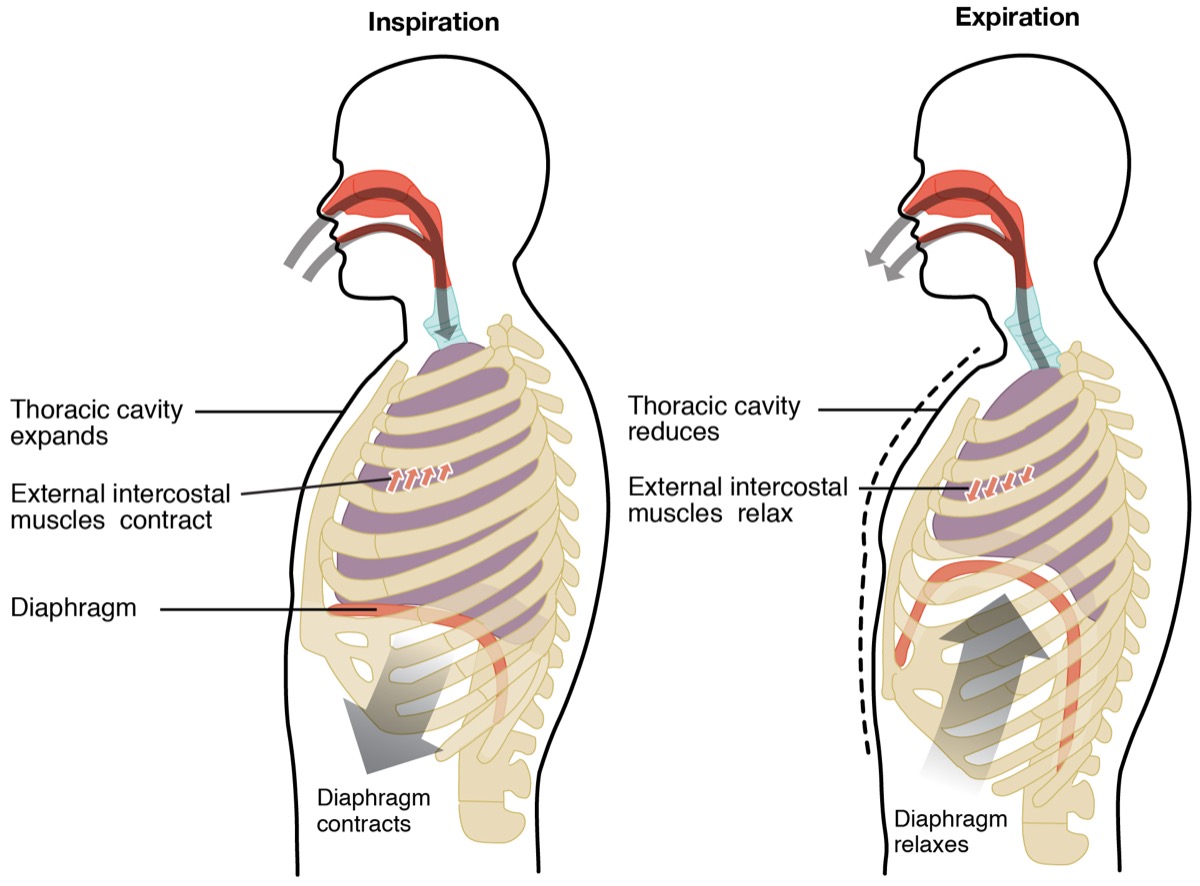

To practice abdominal breathing, follow these steps:
- Place both hands on your abdomen.
- Inhale through your nose slowly and deeply. Imagine the air filling up the bottom of your lungs first and then slowly rising to the top. As your lungs fill up with air, they will push the diaphragm down, which pushes the internal organs to the side, allowing your stomach to rise. You should see your hands rise, but your chest should move only slightly. (Count to 6.)
- Pause for a moment. (Count to 8.)
- Exhale through your mouth, pursing your lips to make it come out slowly and evenly. (Count to 12.) Note: It should take twice as long to exhale as to inhale.
- Repeat the entire process 2-3 times daily.
In fitness class, I tell you to BREATHE. Don’t hold your breath at any time during exercise. Technically, there is a right and a wrong way to breathe while weightlifting, but HOW you breathe is LESS important than the simple fact that you BREATHE.
If you wish to have a pattern to your breathing while lifting weights, there is a simple rule to follow: Since it’s harder to lift a weight than it is to lower it, you need to synchronize the breathing with the difficulty of the movement: Inhale when the weight is being lowered and exhale when the weight is being raised.
There are two ways to achieve this: (1) Begin at the beginning of the exercise, inhale, then exhale as you exert yourself with the upward or harder movement, or (2) Move to the top of the exercise, inhale as you come down, and exhale as you push back up. If you find this uncomfortable, don’t worry about it. Remember what has already been said: How you breathe is less important than the simple fact that you breathe.